On this page
AI Pricing Strategy: Why SaaS Models Fail for AI Startups
 IA
IAAre you underpricing your AI product? Find out why AI startups are ditching SaaS per-seat models for services-as-software and outcome-based pricing.
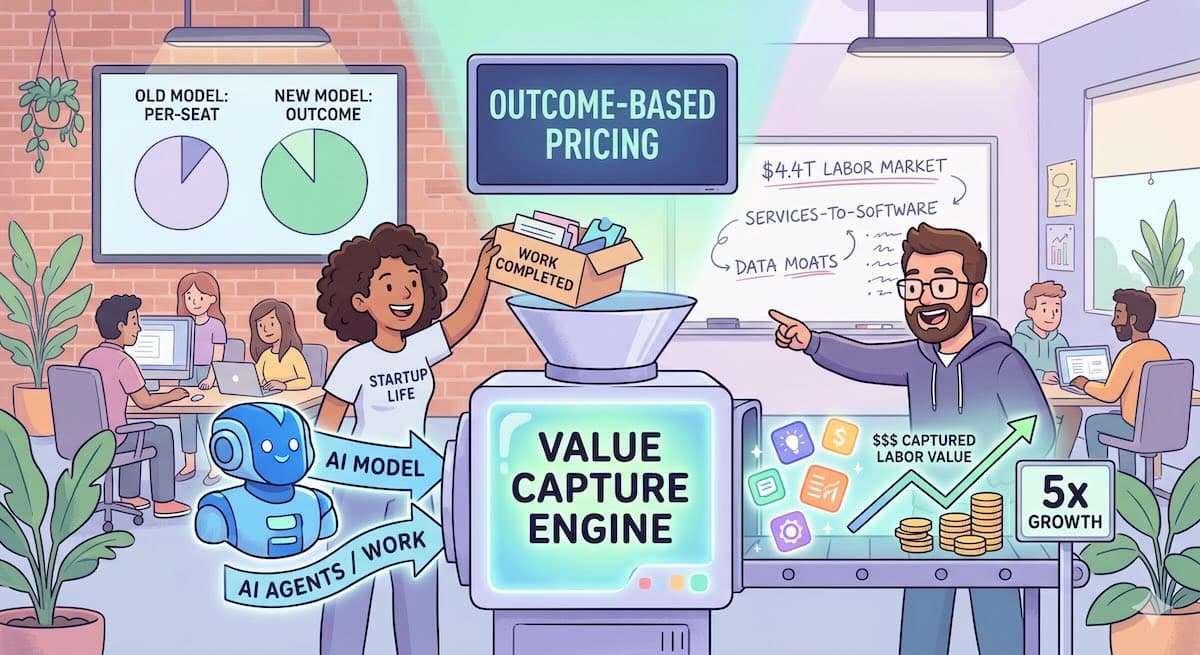
The next wave of AI companies won't lose because their models underperformed. They'll lose because they priced it as if it were 2016. Global software spending is projected at $1.43 trillion this year. IT services, a rough proxy for the labor AI is about to absorb, sit at $1.87 trillion (Gartner, 2025). McKinsey puts the incremental economic potential of tapping labor budgets at $4.4 trillion (McKinsey, 2025). And as a16z's David Haber points out, nursing payroll alone, one subsegment of one industry, is $600 billion, more than twice the entire pre-AI software market (David Haber, a16z, 2026).
If you're building an AI product and still charging by the seat, you're fishing in a pond. There's an ocean next door.
This piece unpacks why the SaaS pricing playbook falls apart when software does the work. You'll see how outcome-based models, consumption pricing, and services-to-software flywheels are reshaping what AI companies can charge. And why the companies that win this cycle won't necessarily have the best AI, they'll have the smartest business models.
Key Takeaways
AI companies that sell labor replacement can charge against a $4.4 trillion labor budget, not the $1.43 trillion software market (McKinsey, 2025).
87% of AI sellers plan to change their pricing model in the next 12-18 months , and per-seat pricing has already dropped from 21% to 15% adoption (Salesforce Ventures, 2025; hy.co, 2026).
The "give away the system of record, charge for the work" model is already producing AI startups with higher ACVs than the incumbents they sit on top of.
Read: Powered revenue engines and sales automation strategy
Watch on YouTube: Bret Taylor on How AI is Reinventing Software Business Models
Why the Total Addressable Market for AI Isn't IT Spend Anymore
For 20 years, SaaS companies competed for a slice of the CIO's budget. That meant the ceiling was always IT spend. David Haber, general partner at a16z, frames the shift bluntly: "The TAM is no longer IT spend. It's really labor" (David Haber, a16z, 2026). This is not a subtle reframing. It means the market for software businesses is about to get dramatically bigger, and the way you capture that value has to change with it.
Think about what happened with every prior software cycle. The HR team accessed on-prem HR software. The same HR team accessed cloud HR software, just distributed differently. The budget line didn't move. But when AI-native software actually does the HR work, screens candidates, schedules interviews, and generates offer letters, the budget it replaces isn't the HR software line. It's the HR payroll line.
This is where most AI pricing strategy still gets it wrong. They're benchmarking against Salesforce and HubSpot when they should be benchmarking against the cost of the human being doing that job. The relevant question isn't "how much should we charge per seat?" It's "how much does it cost to do this work with humans, and what percentage of that value can we capture?"
Read: Services-as-software model for CRM and sales automation → deep dive on managed-loop revenue in B2B
Why Does Per-Seat Pricing Create Perverse Incentives for AI?
Hybrid pricing surged from 27% adoption in 2025 to 41% in 2026, while pure per-seat pricing dropped from 21% to 15% (hy.co, 2026). In the US, 60% of AI providers now use hybrid or usage-based models. The per-seat playbook is already in retreat, and for good reason.
SaaS pricing was built on one assumption: more users mean more value, which means a higher bill. That math works when humans operate the software. Add a sales rep, buy a seat. Hire a customer success person, add a license. Vendor and customer align around growth.
AI flips this equation completely.
When your product automates the work of 10 support agents, the customer's headcount drops from 10 to 2. Under per-seat pricing, your revenue just shrank by 80% while the customer captured all the savings. You built a better product and got penalized for it. Nobody signs up for that deal structure voluntarily.
We've watched the fastest-growing AI products abandon per-seat pricing entirely. They charge by task completed, by outcome delivered, or by a percentage of value captured. The incentive aligns naturally: the more work the AI does, the more the vendor gets paid, and the more the customer saves relative to human labor.
But there's a margin reality that makes this transition urgent. Traditional SaaS gross margins run 80-90%. Average AI-native SaaS margins are 50-60%, and early-stage AI companies can sink as low as 25% (ICONIQ Capital, 2026). Seven in ten software companies with AI products say delivery costs are already eroding profitability, and 52% are building new pricing models specifically to offset those costs (Revenera, 2025).
You can't charge SaaS prices when your costs look nothing like SaaS. So why are so many AI companies still doing it? Per-seat pricing was designed for near-zero marginal cost software. AI products carry real per-use costs, inference compute, API calls, and model hosting. If every additional user costs you money, you need a pricing model that scales with usage, not headcount.
Our observation: Companies that switched from per-seat to consumption-based pricing for AI features reported expanding deal sizes 3-5x within the same accounts. The customer objection isn't price , it's the model not reflecting the value delivered.
What Are the Three Ways AI Companies Enter a Market?
In a recent analysis of the AEC (architecture, engineering, construction) industry, a16z laid out three strategies for attacking legacy software, each of which forces fundamentally different pricing decisions (David Haber, a16z, 2026).
Strategy 1: Build the system of record from scratch. Go head-to-head with the incumbent. Rebuild Revit, rebuild Salesforce, rebuild the EHR. This is the hardest path because distribution advantages and user lock-in are real. The incumbent constrains pricing here. You're still in the IT budget sandbox, just with a newer product.
Strategy 2: Build around the system of record. This is where most activity is happening. Don't replace the existing software. Layer on top of it. Hook into it. Do work that the system of record can't do, ingest unstructured data from email, voice, fax, fire codes, electrical specs, and charge for the outcome. Companies using this strategy are already seeing higher ACVs than the core systems they integrate with. How is that possible? They're tapping the labor budget, not the software budget.
Strategy 3: Do the work. Don't sell software at all. Sell the outcome. Camber, an a16z-backed company, doesn't sell revenue cycle management software to healthcare providers. It says: give us your insurance claims, we'll collect your money, and you pay us a percentage of what we recover. No software license. No per-seat fee. Just outcomes.
This third model is worth examining closely because it's the purest expression of where AI pricing is heading.
How the Services-to-Software Flywheel Works
In healthcare revenue cycle management, the conventional model operates at low-teens gross margins run by call centers full of humans fighting with insurance companies. Healthcare providers in behavioral health often get paid only 75-80% of what they're owed. It's a profoundly fragmented market.
Camber built AI agents that handle the entire claims submission and adjudication workflow. No human billers. Every efficiency gain from automation goes straight to Camber's margin. As Haber described it: "It's sticky revenue. It's hard to sell, but it's very difficult to rip out. It's highly recurring. And any automation and kind of efficiency gains accrue to yourself" (David Haber, a16z, 2026).
The feedback loop here compounds aggressively. The more claims they process, the more data they have on payer behavior, denial patterns, and optimal submission timing. That data improves their AI's collection rate. Higher collection rates win more customers. More customers mean more data. Pricing is baked into the model as a percentage of receivables collected, so every improvement directly compounds revenue.
Read more about the data infrastructure requirements for AI agents → technical guide on building the data layer for autonomous systems
Should the System of Record Be Free?
Joel Spolsky's 2002 essay on commoditizing your complements is having a renaissance in the AI era. The core insight: when complements get cheap, demand for your product goes up. Cheap flights to Miami make Miami hotels expensive. Internet Explorer's free pricing destroyed Netscape (Joel Spolsky, 2002).
Apply this to vertical AI, and you get a genuinely radical proposition.
If you can build AI that does all the valuable work around a system of record, the insurance claims, the fire code compliance, the document review, the demand letters, you might not need to charge for the system of record at all. Give it away. Use it as a distribution channel. Make your money from everything the software enables.
Haber put it this way on the Verticals podcast: "If you can make a lot of money on all of the surrounding work, maybe you don't actually need to charge anything for the system of record, or maybe the system record doesn't even need to exist" (David Haber, a16z, 2026).
The risk for startups is the incumbent doing the reverse, giving away the AI work layer for free while charging for their entrenched system of record. But that requires a long-term orientation, which most public companies don't have. The window is real.
AI Work-Layer Startups Now Out-Earn the Systems They Sit On. Horizontal bar chart showing average contract values. Traditional System of Record ACV is $15K. AI Work-Layer Average ACV is $45K. AI Services-as-Software ACV is $120K. Source: a16z / Bessemer Venture Partners 2026.
AI Work-Layer Startups Now Out-Earn the Systems They Sit On Average Contract Value (ACV)
$0 $30K $60K $90K $120K
Traditional System of Record $15K AI Work-Layer (avg) $45K AI Services-as-Software $120K Source: a16z / Bessemer Venture Partners (2026)
How Should You Price When You're Selling Outcomes?
Per-resolution pricing is already the norm among AI-native companies. Intercom charges $0.99 per AI-resolved ticket and quadrupled Fin revenue year-over-year, while Salesforce Agentforce is priced at $2.00 per resolution (vendor-published pricing, 2026). Here are the models actually working right now. The real question: what economic value does this create, and how do we share in it?
Watch on YouTube: Manny Medina on Pricing in the AI Era
Percentage of Value Captured
The Camber model. You charge a percentage of the financial outcome you deliver. If you collect $1 million in receivables and charge 5%, you make $50k. If you automate the workflow and your margin on that $50k is 80% because AI did the work, you've got a software business disguised as a services business.
Consumption-Based Pricing
Task completion. API calls. Documents processed. Claims submitted. The best versions of this model include a minimum commitment so that the vendor has predictable revenue and the customer treats the product as infrastructure rather than an experiment.
Success-Fee Model
The Eve model in plaintiff law. The AI handles intake, evidence collection, document review, and demand letter generation. The firm pays based on case outcomes. This aligns everyone around the same metric: win more, win faster.
In our experience working with teams deploying these models, buyers don't actually resist them. Buyers resist per-seat pricing for AI because they can do the math and see they're getting a bad deal. Give them a model where the vendor only wins when they win, and the sales cycle compresses. The conversation shifts from "is this tool worth $50/month?" to "can this make us $500k/year?"
Gartner projects that by 2030, at least 40% of enterprise SaaS spend will shift toward usage-, agent-, or outcome-based pricing, and 35% of point-product SaaS tools will be replaced by AI agents or absorbed within larger agent ecosystems (Gartner, cited by Deloitte, 2025). Is that a trend? No. It's a restructuring.
The Data Moat That Makes Pricing Power Compound
There's a second-order effect here that most founders miss. Outcome-based pricing doesn't just align incentives. It creates a genuinely defensible data feedback loop.
Eve, the a16z-backed legal AI company, captures nonpublic case outcome data. What State Farm pays for a motorcycle accident in Michigan doesn't show up in any training set. It is proprietary to Eve. That data lets them tell a new client at intake: "Based on every case we've ever seen with your variables, this case is worth roughly $500k. That one is worth $5k. Prioritize accordingly" (David Haber, a16z, 2026).
That's not a cost-reduction story. That's a revenue-lift story. And it's incredibly hard for a competitor to replicate without years of case data. Pricing power flows directly from data moats, and outcome-based pricing is what lets you build those moats in the first place.
Context engineering vs flow-based agents → architecture comparison for AI-native applications
What This Means for Founders and Buyers Right Now
AI Pricing Models Are Shifting Fast — Per-Seat Is in Retreat. Grouped bar chart comparing AI pricing model adoption in 2025 vs 2026. Per-seat: 21% to 15%. Hybrid (subscription + usage): 27% to 41%. Usage-based: 22% to 22%. Outcome-based: 2% to 5%. Source: hy.co / SaaS and AI Pricing Report 2026.
AI Pricing Models Are Shifting Fast — Per-Seat Is in Retreat Share of AI Products Using Each Pricing Model

For AI Founders
Market structure matters more than market size. Why do so few founders internalize this? If you're entering a vertical with one dominant system of record holding 40-60% market share, going head-to-head on features is suicide. Start with the work. Ingest the messy data nobody has structured yet, voice calls, faxes, emails, and PDF attachments. Own that workflow. Charge for outcomes. Become the system of record later, once your data moat is unassailable.
Haber's advice to early-stage AI companies reflects this: "It's better to be complementary than directly competitive. Over time, that dynamic may change" (David Haber, a16z, 2026).
For Enterprise Buyers
If an AI vendor pitches you per-seat pricing for something that automates work, push back. That model is structured to benefit them in the short term and punish you in the long term. Ask for outcome-based pricing. Tie their revenue to your results. The advantage is yours, for every AI vendor, there are three behind them willing to innovate on the business model.
The real strategic risk for buyers isn't overpaying for AI tools. It's those competitors who adopt outcome-priced AI that will restructure their cost base in ways you can't match from inside a traditional SaaS procurement model.
Learn how to build the business case for AI revenue tools → financial modeling framework for AI procurement
Watch on YouTube: Why Vertical LLM Agents Are The New $1 Billion SaaS Opportunities.
Frequently Asked Questions
Should every AI product abandon per-seat pricing?
Not every product. Collaboration tools and platforms where headcount directly correlates with usage can still justify seat-based models. But if your AI does work that replaces human effort, per-seat pricing eventually conflicts with both your growth and your customers' incentives. Outcome or consumption models scale better.
What's the hardest part of transitioning to outcome-based pricing?
Measurement. You need to define the outcome precisely, track it reliably, and attribute it to your product unambiguously. This requires data infrastructure that most early-stage companies don't have. Start with a consumption model as a stepping stone, charge by task or operation, and layer on outcome pricing once measurement is solid.
How do incumbents respond to AI-native pricing models?
Two paths. The smart ones will let startups build on their platform and effectively tax them through API access fees, marketplace fees, or a platform revenue share. The defensive ones will try to block third-party AI tools from their ecosystem and build everything themselves. The latter rarely works; customers eventually demand open APIs when the value of the surrounding AI tools becomes too large to ignore.
Can AI services businesses actually achieve software margins?
Yes, but it takes discipline. Camber started with humans in the loop and gradually automated them out, with each efficiency gain compounding to the margin. The key is starting in a domain where the work is structured enough to be automated incrementally, RCM, legal document review, insurance claims processing, not creative or highly variable work where the long tail of edge cases keeps humans permanently in the loop.
What verticals are ripest for outcome-based AI pricing?
Financial services middle and back office is the sleeper hit. As Haber noted, even Goldman Sachs, with 10,000 engineers and an elite tech brand, still runs large chunks of its operations through humans in Excel, "not using Excel to do modeling but using Excel to track work" (David Haber, a16z, 2026). If that's Goldman, imagine the regional insurance company in Ohio. Healthcare, legal, and industrial software are all similarly document-intensive and human-heavy. The wedge is there.
Stop adding AI tools and restructure your engineering org → organizational design for the AI era
Conclusion
The AI companies that IPO this cycle won't look like Salesforce. They'll look like Camber. They'll sell outcomes, not seats. Their TAM will be a payroll line item, not a software budget line. And their pricing page might not mention "per user" at all.
Three things to remember:
The market is 50x bigger than SaaS. US payroll dwarfs global software spend. Companies that figure out how to capture labor budgets will build the biggest businesses of this cycle.
Per-seat pricing is a trap. AI products that work well will shrink their own revenue under seat-based models. Consumption, outcome-share, and success-fee models align incentives and scale with impact.
Data moats compound through pricing. Outcome-based models generate proprietary data on what works, which feeds back into better AI, which drives better outcomes, which attracts more customers. That flywheel is the real defensibility.
The best AI won't win. The best business model will. And isn't that the real lesson here?