
How Do AI Agents Work? The Complete Architecture Deep-Dive
Only 12% of AI agents in production achieve high ROI. Discover the underlying architecture of AI agents, including memory, tools, and multi-agent frameworks

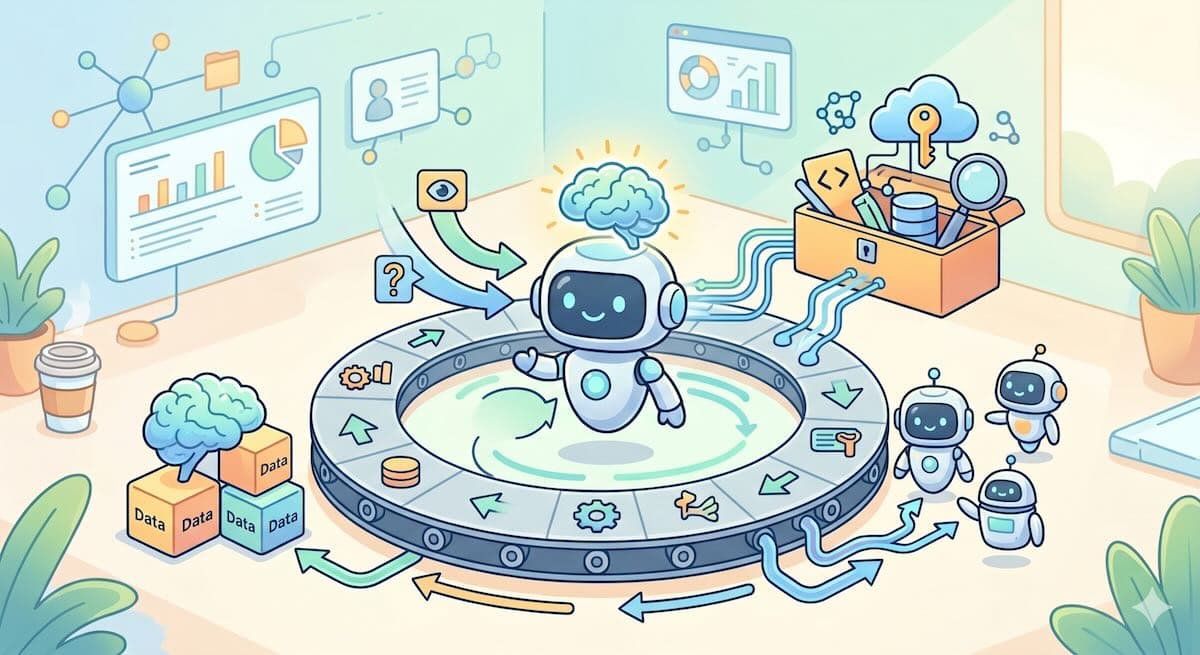
Everyone's shipping "AI agents." But most of them aren't agents at all. 57.3% of organizations now have agents in production, up from 51% six months earlier, and 67% for enterprises with 10K+ employees (LangChain, 2025). Yet only 12% of deployments achieve 300%+ ROI, 88% sit at or below break-even (AIMultiple, 2026).
The difference isn't the model. It's the architecture. You can give GPT-5 to a team that wraps it in a while loop and calls it an agent. You'll get a chatbot that sometimes does things. A real agent system, one that plans, remembers, uses tools, and recovers from failure, looks nothing like that under the hood.
This piece walks through the actual engineering. No vendor demos. No "just add AI" magic. We'll unpack the core loop, how memory actually works, tool orchestration, multi-agent patterns, guardrails, and why most agents fail in production.
Key Takeaways
57.3% of orgs have agents in production, but only 12% achieve 300%+ ROI architecture, not model selection, separates the winners (AIMultiple, 2026)
The agent loop (Perceive → Reason → Act → Observe) is fundamentally different from an LLM call tool orchestration alone accounts for a ~30-point performance gap on GAIA benchmarks
76%+ of organizations use multiple LLM models; 57% aren't fine-tuning at all, relying instead on prompt engineering and RAG (LangChain, 2025)
Multi-agent architectures fall into three topologies pipeline, hub-and-spoke, and mesh and picking the wrong one for your task is the most common scaling failure
[INTERNAL-LINK: AI agent strategy fundamentals → pillar page on building production-ready LLM systems]
How Does the Agent Loop Actually Work?
54% of enterprises deployed AI agents enterprise-wide in Q1 2026, up from just 11% in 2023 and 33% in mid-2024 (KPMG, Q1 2026). That's a 5x jump in three years. But what are these organizations actually deploying?
Under the hood, every agent, whether it's a coding assistant, a customer support bot, or a revenue operations tool, runs the same fundamental loop. The agent perceives its environment, reasons about what to do next, acts by calling a tool or generating output, observes the result, and repeats. The LLM isn't the agent. It's the reasoning engine inside the loop. The agent is the entire system: the model, the tools, the memory, and the orchestration logic that keeps the loop running until a termination condition is met.
Enterprise AI Agent Adoption (% in Production) Line chart tracking enterprise AI agent production adoption: 11% in 2023, 33% in Q2 2024, 42% in Q3 2025, and 54% in Q1 2026. Data from KPMG AI Quarterly Pulse Survey. 0% 10% 20% 30% 40% 60% 2023 Q2 2024 Q3 2025 Q1 2026 54% 42% 33% 11% Source: KPMG AI Quarterly Pulse Survey (Q1 2026)
This loop is simple to describe but hard to get right. The reasoning step needs the model to decompose a task, decide which tool to call, and format the tool invocation correctly. The observation step must parse the tool's output and feed it back into the context. A single mistake in any phase a badly formatted function call, a tool that returns 50KB when you needed 200 bytes, a reasoning step that loses the thread and the loop degrades into expensive nothing.
According to the GAIA benchmark, the top scaffolded AI agent scores 74.55% compared to a 92% human baseline. Bare LLMs without tool orchestration score around 44% (Princeton HAL / GAIA, 2026). That roughly 30-point gap is what the agent architecture layer buys you. Remove the tools, the memory, the planning, and you lose a third of the capability.
GAIA Benchmark: The Architecture Gap Grouped bar chart showing GAIA benchmark scores: Human baseline at 92%, top scaffolded agent at 74.55%, and bare LLM without tool orchestration at 44%. Source: Princeton HAL / AgentMarketCap (2026). GAIA Benchmark Scores (2026) 0% 25% 50% 75% 100% 92% Human 74.55% Top Agent 44% Bare LLM Source: Princeton HAL / AgentMarketCap GAIA Benchmark (2026)
What Makes an Agent Different From a Chatbot?
62% of organizations are now experimenting with or deploying AI agents, but only 23% are scaling them (McKinsey, 2025). The gap between "experimenting" and "scaling" usually comes down to one thing: mistaking a chain of LLM calls for an agent.
Here's the spectrum. A simple LLM call takes input, returns output, and is done. A chain pipe's output from one call into the next, no branching, no tool use. A true agent adds three things: the ability to choose what to do next (not just follow a script), access to external tools, and a persistent state that survives across steps. A multi-agent system distributes these capabilities across specialized agents that coordinate with one another.
Why does this distinction matter? Because wrapping an LLM in a for-loop and calling it an agent is the single most common architecture mistake I see in production reviews. The model loops, calls itself, loses context, hallucinates a tool call, and burns $4 in tokens before the user gets an answer. That's not a bug. That's what happens when you skip the architecture.
What I've seen: I've watched teams ship an "agent" that was just a while loop around
claude.say(). It worked great in the demo. In production, it averaged 11 turns per task, burned through 80K context tokens per session, and occasionally decided the best way to "look up the customer" was to hallucinate a JSON blob. The fix wasn't a better model it was adding structured planning, a tool registry with schemas, and a hard limit on loop iterations.
Custom-built AI reaches production 4.2x more often than purchased tools, 83% versus 20% (Forrester, 2026). Teams that understand the architecture ship. Teams that treat it as a black box don't.
How Do Agents Remember What They're Doing?
89% of organizations have implemented observability for AI agents, and 62% have full detailed tracing (LangChain, 2025). The reason so many teams invest in watching their agents is that agents constantly forget things, and debugging memory loss without tracing is a nightmare.
An agent has three memory layers, and confusing them is where most implementations go sideways.
Working memory lives in the context window. It's everything the model can "see" right now: the system prompt, the conversation history, tool call results, and any retrieved documents. This is fast and coherent but finite. Claude's context window handles 200K tokens. Dump 180K raw logs into it, and the model's attention diffuses into irrelevant noise.
Long-term memory is external storage, typically a vector database. Documents, past conversations, and knowledge base entries get chunked, embedded, and retrieved when relevant. This is where RAG (retrieval-augmented generation) lives. The trick isn't storing things; it's retrieving the right things at the right time without blowing up the context budget.
Episodic memory, the record of what the agent actually did, is the one most teams skip. Logging every action, every tool call, every outcome isn't just for debugging. It's how the agent learns across sessions. An agent that can reference "last time I tried this API with these parameters, it returned a 422" is fundamentally more capable than one that starts from scratch every time. Very few production systems implement this well.
What I've seen: The context window is both the agent's greatest asset and its biggest liability. One team I worked with had their agent retrieving 15 "relevant" documents per turn by turn 4 the window was drowning in redundant chunks, the model started confusing document A's pricing with document B's policy, and the error rate tripled. Cutting retrieval to the top 3 most relevant + a dedup pass dropped error rates by 40% and halved token costs.
How Do Agents Actually Use Tools?
76%+ of organizations use multiple LLM models; they're not locked into a single provider. And 57% aren't fine-tuning at all, relying instead on prompt engineering and RAG (LangChain, 2025). This multi-model reality means tool definitions have to be portable, not locked to OpenAI function calling or Anthropic tool use format.
Tools are the difference between an agent that thinks and an agent that does. Every tool is a contract: a schema that declares what parameters it accepts, a function that executes when called, and a return format the model can parse. The model doesn't execute tools. It proposes which tool to call and with what arguments. The agent runtime validates, executes, and feeds the result back.
The most common tool types in production agents:
API calls: HTTP requests to internal services or third-party APIs. Structured, idempotent, with defined error responses.
Code execution: sandboxed environments where the agent writes and runs code. Powerful but dangerous without resource limits and timeouts.
Web search: fetching live data that the model wasn't trained on. Ground responses in current information.
Filesystem access: reading and writing files, often used by coding agents.
Database queries: structured read/write access, usually with read-only replicas to limit blast radius.
The tool registry matters more than the individual tools. Every tool needs a clear, model-understandable description, a strict input schema, and an output contract. Vague tool descriptions produce hallucinated parameters. Missing error contracts mean the model can't recover when a tool fails.
AI agents now handle roughly 78% of e-commerce tasks autonomously, with top-quartile deployments reaching 89% (AIMultiple, 2026). But success drops off sharply after tasks requiring roughly 35 human-minute equivalents. The ceiling isn't the model's intelligence. It's the tool surface area. Every capability you don't expose as a well-defined tool is a task the agent physically cannot complete.
[INTERNAL-LINK: context engineering vs flow-based agent architectures → deep-dive on dynamic tool selection and progressive disclosure]
When Do You Need Multiple Agents?
LangChain dominates agent framework adoption at 62% of agencies building agents. LangGraph has grown by 890% year-over-year, making it the fastest-growing agent framework. CrewAI follows at 340% YoY growth (AgentList.directory, 2025). The explosion isn't hype. It reflects a real architectural insight: complex tasks need specialized agents, not one monolithic generalist.
Multi-agent systems fall into three topology patterns, and the choice determines everything about how your system scales and fails.
AI Agent Framework Adoption (2025) Bar chart showing AI agent framework market share among agencies: LangChain 62%, CrewAI 24%, OpenAI Assistants 21%, AutoGen 19%, LlamaIndex 18%, LangGraph 15%. Source: AgentList.directory Trends (2025). Agent Framework Adoption (% of Agencies) 20% 40% 60% 80% LangChain 62% (+890% LangGraph YoY) CrewAI 24% (+340% YoY) OpenAI Asst. 21% AutoGen 19% LlamaIndex 18% LangGraph 15% Source: AgentList.directory Trends (1,871 verified agencies, 2025)
Pipeline topology chains agents sequentially. Agent A's output is Agent B's input. This is the simplest pattern: think document processing: scrape → clean → analyze → summarize. Each agent does one thing well. The failure mode is obvious: if Agent B fails, everything downstream stalls. Good for linear workflows where each stage is independently testable.
Hub-and-spoke topology uses a central coordinator that delegates to specialist agents. The orchestrator agent receives the task, breaks it into subtasks, assigns each to the right specialist, and synthesizes the results. Think of a customer support system where a routing agent sends billing questions to a billing agent, technical issues to a tech agent, and account changes to an admin agent. This is the most common production pattern because it's debuggable, and you can test each specialist in isolation.
Mesh topology lets agents communicate peer-to-peer without a central coordinator. Each agent can call any other agent. This is powerful and dangerous. Without centralized oversight, agents can get stuck in loops, send garbage to each other, or diverge in their interpretation of goals. Mesh topologies need the strongest observability and termination guarantees.
Most teams reach for mesh because it looks elegant in a diagram. In practice, hub-and-spoke with a well-defined coordinator almost always outperforms mesh for the first year of production. The coordinator gives you a single place to add guardrails, logging, and termination logic. Mesh gives you emergent behavior you can't debug. Pick boring architecture first.
Why Do Most Agents Fail in Production?
89% of organizations use observability for agents, and 94% of those in production do (LangChain, 2025). The reason observability adoption outpaces even agent adoption itself is that agents fail in unpredictable ways, and nobody trusts them enough to run blind.
The most common failure modes in production agent systems break down like this:
Top Barriers to AI Agent Production Deployment Lollipop chart ranking barriers to production: unclear ROI at 59%, data readiness at 58%, quality and reliability at 32%, security and compliance at 25%, and latency at 20%. Sources: LangChain, DigitalOcean, Mayfield (2025-2026). 10% 20% 30% 40% 50% 60% Unclear ROI 59% Data readiness 58% Quality/reliability 32% Security/compliance 25% Latency 20% Sources: LangChain State of Agent Engineering (2025), DigitalOcean (2025), Mayfield (2025)
ROI uncertainty is the biggest killer. 59% of organizations cite unclear return as a blocker, higher than technical concerns like latency or security. The root cause is almost always the same: a lack of a measurement framework. Teams can't tell you whether the agent is saving time or just burning GPU cycles because they never instrumented the baseline.
But the technical barriers are real, too. Agent quality and reliability (32%) remains the top engineering concern. The NIST AI Agent Standards Initiative is actively developing evaluation frameworks, but we're early. Most teams run agents with the equivalent of "check if the output looks right," no structured eval harness, no regression tests, no latency budgets.
Effective guardrails need three layers:
Input validation: sanitize and validate all inputs before they reach the model. Injection isn't just a web problem; it's an agent problem.
Action gating: not every tool call the model proposes should execute. Destructive operations (writes, deletes, sends) need human confirmation or policy checks.
Output verification: validate structured outputs against schemas. If the agent is supposed to return JSON with specific fields, enforce it at the gateway, not in the retry loop.
[INTERNAL-LINK: AI agent testing and evaluation strategies → guide to building reliable agent eval harnesses]
Video: AI agent design patterns (Part 1) by Google Cloud Tech. Covers single-agent, sequential, and parallel agent patterns with code examples.
Where Agent Architectures Are Heading Next
Enterprise AI spending hit $37 billion in 2025, 3.2x what it was in 2024. 72% of enterprises now call AI "critical infrastructure" (McKinsey/Menlo Ventures, 2025-2026). Agents are becoming infrastructure, not experiments. That shift changes what architecture means.
Three trends are redefining agent architecture in 2026:
Self-improving loops. The best agents don't just execute tasks; they learn from every execution. Each tool call outcome, each user correction, and each failure mode gets logged, analyzed, and fed back into the system prompt or fine-tuning dataset. This closes the gap between "works in the lab" and "works in production." It's also the hardest thing to build correctly because bad feedback loops amplify mistakes rather than correct them.
Agent-to-agent protocols. Google's Agent2Agent protocol and Anthropic's Model Context Protocol are converging on standards for how agents discover one another, negotiate capabilities, and hand off tasks. The next 18 months will determine whether this becomes a real interoperability layer or another stack of abandoned RFCs.
Time is a first-class concept. The OpenClaw framework's key architectural insight is that autonomous agents need time awareness, not just timestamps, but understanding of duration, deadlines, and "how long should I keep trying before I escalate." Most agents today have no concept of time beyond the next API call. The ones that ship at scale will treat time as a core dimension of decision-making, not an afterthought.
The frameworks that win won't be the ones with the most features. They'll be the ones that make the boring stuff easy: state management, failure recovery, and cost control. The agent loop is genuinely simple: perceive, reason, act, observe. The hard part is making it reliable, observable, and cheap. That's where the real architecture work lives.
Video: 3 Advanced AI agent design patterns (Part 2) by Google Cloud Tech. Covers loop/review-critique, coordinator/router, and agent-as-tool patterns.
[INTERNAL-LINK: agentic CRM and coding agents → how revenue teams use coding agents to build custom business software]
Frequently Asked Questions
What's the difference between an AI agent and an LLM?
An LLM is a text prediction engine. An AI agent is a system that uses an LLM as its reasoning core but adds tools, memory, planning, and an execution loop. The GAIA benchmark shows bare LLMs score 44% while scaffolded agents reach 74.55% (Princeton HAL, 2026). The ~30-point gap is what the agent architecture layer provides.
Do I need a multi-agent system, or is a single agent enough?
Start with a single agent. 62% of organizations running agents are still primarily using single-agent architectures (AgentList.directory, 2025). Add a second agent only when you have a sub-task that's independently testable and has different tool or prompt requirements than the main agent. Premature multi-agent architectures are the most common source of unnecessary complexity.
How do I handle agent failures in production?
Three layers: input validation before the model sees anything, action gating before destructive tool calls execute, and output verification against expected schemas. 89% of production teams run observability with full tracing (LangChain, 2025). If you can't trace why an agent did something, you can't fix it.
Which agent framework should I use?
LangChain dominates with 62% adoption, but LangGraph is the fastest-growing, at 890% YoY, among teams building custom orchestration (AgentList.directory, 2025). If you're building a simple agent with straightforward tool use, LangChain's abstractions work. If you need fine-grained control over the execution graph and state management, LangGraph is the better bet.
[INTERNAL-LINK: LLM wiki and Claude Code setup guide → how to build your own agent knowledge base]
Conclusion
AI agents aren't magic. They're software systems with an LLM at the center, tools at the edges, memory between calls, and an execution loop holding it all together. The architecture matters more than the model, and the difference between 12% and 300%+ ROI is deployment discipline, not a better API key.
Build boring architecture first. Instrument everything. Test each component in isolation. A working single agent with good observability beats an elegant multi-agent mesh that nobody can debug.
Read: Strategic knowledge management for AI teams → how to stop documenting everything and start keeping what matters.