
AI in B2B Sales: How Managed Loops Are Replacing CRM Services
For every $1 spent on CRM software, $6 goes to manual services. Learn how AI-powered managed revenue loops are replacing sales admin and boosting pipeline.

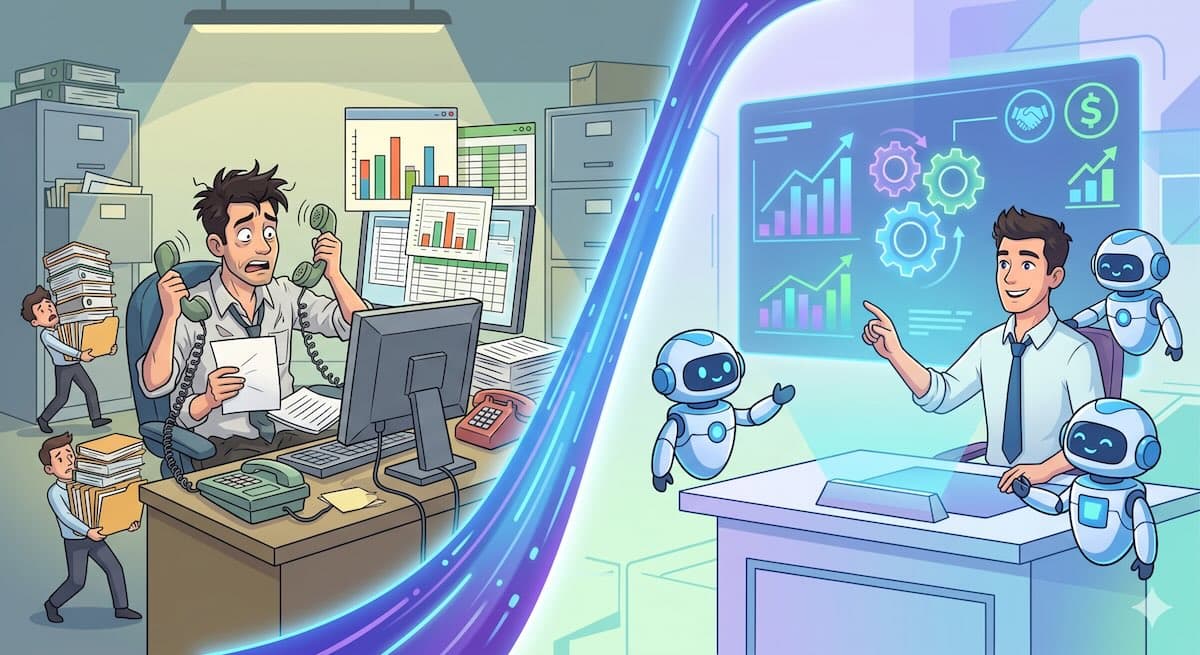
The next trillion-dollar company won't sell you better CRM software. It'll sell you revenue outcomes. For every $1 companies spend on CRM software licenses, they spend $6 on implementation, consultants, managed services, and outsourced operations (Sequoia Capital, 2026). That $6 is up for grabs. And everyone from a16z to YC knows it.
This piece breaks down the managed-loop model for B2B sales. You'll see why most teams are automating the wrong things. And you'll get the specific architecture to run AI from BDR outreach all the way to close.
Key Takeaways
Sales reps spend just 28% of their time selling. The rest is CRM admin, research, and internal overhead (Salesforce State of Sales, 2026).
Hybrid pods (1 human + AI agents) generate 48% more pipeline per seat than human-only teams (RevOps Co-op, 2026).
AI alone doesn't win. Loops with human judgment layered on top do.
What the $1-to-$6 Ratio Actually Means for CRM
The global CRM market hit $287 billion in 2025, growing to $334 billion this year (Research and Markets, 2026). Apply the $1-to-$6 ratio and you get roughly $88 billion in software licenses and $199 billion in services layered on top.
That services layer is not magical. It is humans doing the work the software was supposed to do but didn't. CRM enrichment. Pipeline hygiene. Forecast roll-ups. Sequence management. Lead routing. Reporting decks. Integration maintenance. Every company has a small army of RevOps, sales ops, and enablement people whose job is basically making the CRM usable.
This is not a software problem anymore. It is a labor problem hiding inside a SaaS budget.
The CRM software industry spent 20 years building better databases. Salesforce, HubSpot, and Dynamics all competed on features. But the bottleneck was never the database. The bottleneck was the human effort required to keep the database accurate, current, and useful. That is why for every dollar of software, six dollars went to humans doing work the software was never designed to absorb.
The question services-as-software asks is simple. What if all $7 of that could be delivered by AI as a managed outcome instead of a tool plus a consulting engagement?
Why Are Most Sales Teams Using AI Completely Wrong?
47% of AI SDR deployments fail within three months, and 21% never recover (RevOps Co-op, 2026). Most teams aren't failing because the AI is bad. They're failing because they bolted AI onto broken sales processes and called it innovation.
The instinct is obvious. Take your existing sales machine. Add AI. Expect magic.
What you get instead: faster bad emails, more generic sequences, dashboards nobody reads generated twice as fast, and AI SDR tools that hit domain reputation walls inside 90 days.
That is not the failure rate. That is a category error.
Sales teams are buying AI the way they bought Salesforce in 2012, as a tool. Give reps a better hammer. But services-as-software is not about better tools. It is about absorbing the work in its entirety.
We watched this play out across revenue teams. Every sales org bought AI SDR tools to send more emails and generate more sequences. Nobody changed the operating model. The emails got faster. The pipeline didn't improve. The winning move wasn't better tools, it was managed loops: end-to-end processes that turn raw signals into a qualified pipeline without an expensive human maze in the middle.
The same shift is hitting revenue teams now. The question isn't "which AI SDR tool should we buy?" The question is "who owns the outcome?"
Salesforce found 87% of sales orgs now use some form of AI, and 96% of revenue leaders expect teams to be AI-equipped by year-end (Salesforce State of Sales, 2026). Adoption is not the problem. Architecture is.
What's the Right Architecture for AI-Powered Sales?
Sales reps spend only 28% of their time actively selling. CRM data entry alone eats 17% of the work week (Salesforce, 2026). The right architecture doesn't give reps better tools, it absorbs the non-selling work entirely through a three-layer stack.

The managed loop owns the outcome, from signal to qualified pipeline to close. Specialist agents execute specific tasks inside each loop. Humans own what machines cannot: strategy, buyer trust, offer architecture, when to push, when to walk, what to kill, what to scale.
The human does not go away. The human moves up.
Sales reps should not spend 17% of their week on CRM data entry (Salesforce, 2026). They should not rebuild the same account research every morning. They should not chase missing fields, clean duplicates, or manually roll up a forecast that will be wrong anyway.
That work should be codified. Run by agents. Watched by humans.
Most sales orgs have an inverted architecture. The most expensive people do the cheapest work. Enterprise AEs making $300K OTE spend hours updating deal stages, writing internal notes, and building their own prospecting lists. That is not efficiency. That is organizational malpractice disguised as "being hands-on."
Which Revenue Loops Actually Replace Manual CRM Work?
Sellers who frequently use AI generate 77% more revenue per rep than non-users (Gong Labs, 2026). But the revenue bump doesn't come from giving reps chatbots, it comes from wiring AI into end-to-end loops that own outcomes, not tasks. Here are the seven loops I'd build for a revenue services company.
1. The Buyer Signals Loop
Most outreach fails because the inputs are stale. A BDR gets a ZoomInfo export from last quarter, a three-sentence ICP description, and a sequence template written by marketing six months ago. Then everyone acts surprised when reply rates are 2%.
The buyer signals loop continuously collects:
Intent data (who is researching your category right now?)
Job changes and promotions
Funding events and hiring surges
Tech stack changes
Competitor engagement
Content consumption
Past deal context
This does not happen once at account assignment. It runs the entire relationship. Stale signals produce stale pipeline.
2. The AI SDR Outreach Loop
Algorithms reward relevance. Not volume. Relevant volume.
The old model: one BDR writes five email variants, their manager reviews them in a weekly 1:1, and the sequence goes live 10 days later. The new model: AI produces 100 outreach variants from buyer signals, kill 80 in QA, launch 20, and watch which ones actually start conversations.
Hybrid pods (1 human BDR + 2-4 AI agents) generate $278K in pipeline per seat per month. Pure human pods generate $187K. Pure AI pods generate $94K. The cost per qualified opportunity drops 54%, from $487 to $224 (RevOps Co-op, 2026). AI alone produces volume but no trust. Human alone produces trust but no scale. Together, they compound.
The human BDR in this model does not write emails. They judge AI output, handle edge cases, and jump in when a real person replies. Taste, not typing.
3. The Lead Qualification Loop
An inbound lead shows up. Now what?
In most companies, someone manually enriches the record, scores it against BANT or MEDDIC, routes it to the right rep, and follows up three days later. By then, the buyer has already spoken to a competitor.
The qualification loop should:
Auto-enrich every lead with firmographics, tech stack, intent signals, and recent news
Score against your actual ICP using historical close data (not a checkbox form a VP filled out in 2023)
Route instantly to the right rep based on territory, capacity, and historical win patterns
Trigger the right follow-up sequence based on buyer role, industry, and signal strength
This is not a routing rule in your CRM. It is a model that gets smarter every time a deal closes or dies.
4. The Pipeline Management Loop
79% of sales organizations miss their forecast by more than 10% (Gartner/Xactly, 2025). The median B2B forecast variance is +/-15-25%. Think about how much boardroom drama and rep anxiety that number represents.
The pipeline loop watches every deal between opportunity creation and close. It flags:
Deals sitting too long in one stage
Deals with no recent contact activity
Deals where the buying committee has fewer contacts than the average closed deal
Deals missing key competitors in the opportunity record
Forecasting anomalies based on rep history (some reps sandbag, some rep hero-shot everything)
The job is not to nag reps about updating CRM fields. The job is to find where momentum is dying and surface it before the weekly pipeline call becomes a blame allocation ceremony.
AI-assisted forecasting improves accuracy by 15-25% over manual rep roll-ups (Optifai, 2025). That is fine. But the bigger prize is not better spreadsheets. It is fewer deals dying quietly in stage three while the VP of Sales is building a board deck.
5. The Deal Intelligence Loop
Most pipeline reviews are expensive storytelling. The VP asks what happened. The rep narrates the version where everything is going great and the deal closes next week. Neither person has real signal.
A deal intelligence loop should answer five questions, no narrative required:
What changed on this deal this week?
Which deals are actually stalling vs. progressing normally?
What objections keep surfacing across the pipeline?
Which deals need executive involvement right now?
What pattern separates won deals from lost ones this quarter?
This is not a dashboard. It is a decision queue. The human does not interpret charts. The human makes calls based on pre-digested signal.
When we built narrative loops for marketing clients, we found the single biggest unlock was killing the "what happened" section of the report entirely. Nobody needs a recap. Everyone needs a decision. The same is true for pipeline reviews. If AI can tell you what changed and what you should do about it, the meeting goes from 60 minutes to 15.
6. The Closing Execution Loop
The average B2B sales cycle is 102 days. For $50K-$100K deals, it stretches to 120 days (DealRecovery.ai, 2025). Buying committees average 6.3 stakeholders. Every additional week is a chance for a competitor to slip in, a budget to get frozen, or a champion to go quiet.
The closing loop should continuously ask:
What objections keep killing deals at this stage?
What proof, case studies, or ROI models do reps need for this specific objection?
Which buyer personas are not yet engaged?
What competitor claims need counter-positioning?
Then it should create the assets. Multi-threading emails. Executive summaries. ROI calculators. Competitor battlecards. Custom proposals. Not "we'll get creative on that next sprint." Now.
7. The Revenue Learning Loop
This is the moat.
If your sales org closes 500 deals a year and each one resets the learning to zero, you do not have a revenue engine. You have expensive pattern amnesia.
The learning loop captures:
Winning subject lines, hooks, and call openers
Objection patterns and which responses actually work
Sequence cadences that produce meetings vs. ones that burn domains
Forecast accuracy by rep, segment, and deal size
Onboarding gaps (deals that die in the first 30 days post-close)
Qualification criteria that actually predict close vs. ones that just sound good in MEDDIC training
Then those learnings feed back into the other six loops. Outreach gets smarter. Qualification gets tighter. Pipeline signals get sharper. Every deal improves the system for the next one.
What Happens When You Codify Revenue Expertise?
78% of B2B companies now have a dedicated RevOps function, up from just 30% in 2021 (SyncGTM, 2026). But most RevOps teams still spend their time on manual CRM hygiene instead of building compounding systems. Codified expertise changes that equation.
SKILL.md files codify expertise into reusable infrastructure. A skill file tells the system when to use a workflow, what inputs are required, what good output looks like, what failure looks like, and what needs human approval before shipping.
The same concept applies to revenue. Every sales organization has 20 people carrying around mental playbooks that never get written down. The AE who has been closing enterprise deals for eight years knows exactly what an at-risk deal sounds like. But nobody else can hear it.
Codified expertise turns that into infrastructure.
A sales skill file might define:
Objection handler: When a buyer says "we're happy with our current vendor," here are the three questions that actually shift the conversation. Here is what bad responses look like. Here is what needs manager approval.
Deal inspection: When an opportunity hits $100K+, run this diagnostic. Check for these five risk signals. Flag if the champion hasn't engaged in 14+ days.
Proposal builder: Given deal stage, buyer industry, competitor, and use case, assemble the right case study, the right ROI model, and the right pricing structure.
Without codified skills, AI agents improvise. And improvisation at scale is just chaos plus nice formatting. With codified skills, AI agents repeat the best version of every workflow, improve from feedback, and hand humans a better starting point every time. The revenue org starts compounding.
Labor resets to zero every time someone quits. Infrastructure compounds every time a deal closes.
What Does a Revenue Service Company Actually Sell?
For every $1 spent on CRM licenses, $6 goes to services that make the software usable (Sequoia Capital, 2026). A revenue service company doesn't sell software access, it sells the managed outcome that used to require both the tool and the $6 services layer on top.
The old model sells pieces. Inbound. Outbound. Enablement. RevOps. Each function bills separately. The client buys the pieces and hopes they add up to pipeline and revenue.
But revenue is not a menu of services. Revenue is moving a company closer to a deal. Every function should exist because it moves a deal forward. If it does not, it's probably expensive theater with better dashboards.
Sellers who frequently use AI generate 77% more revenue per rep than non-users (Gong Labs, 2026). Organizations with AI as a core strategy report 31% higher revenue growth. Numbers are clear. But the org chart hasn't caught up.
The real question for every sales leader is this. If AI makes execution 10x cheaper, what do you still need a human for?
The answer: taste. Judgment. Strategy. Trust. The ability to read a room, a deal, or a buyer's silence and know what to do next. The ability to decide what to kill and what to scale. The ability to turn messy, incomplete signals into a clean action queue.
Some roles get more valuable. Some get exposed. That is uncomfortable, but pretending otherwise is how companies politely decline over 18 months.
Frequently Asked Questions
Is services-as-software just outsourcing with better branding?
No. Outsourcing moves work from your employees to someone else's employees. Services-as-software moves work from humans to managed AI loops. The 54% cost reduction per qualified opportunity in hybrid pods (RevOps Co-op, 2026) comes from automation, not cheaper labor.
What happens to BDR teams when AI handles outreach?
The role shifts from writing emails to judging AI output and handling human replies. Hybrid pods with 1 human + 2-4 AI seats generate 48% more pipeline than human-only teams (RevOps Co-op, 2026). The BDR becomes an orchestrator, not a typist.
Can AI actually close enterprise deals?
No. And it shouldn't try. 96% of revenue leaders expect AI adoption by end of 2026 (Salesforce, 2026), but closing requires trust, relationship, and judgment that AI doesn't have. AI handles what happens around the close: proposal assets, objection research, competitive intelligence, multi-threading content. Humans handle the actual buyer relationship.
How fast can a revenue learning loop start paying off?
AI ramp time is 24 days vs. 142 days for a human BDR (Bridge Group, 2026). The learning compounds from the first deal cycle. Most teams see measurable improvements in forecast accuracy and conversion rates within two quarters of deploying a managed loop with learning capture.
What's the difference between an agent and a loop?
An agent does one job inside a loop: research, writing, QA, analytics. The loop owns the outcome from inputs to results to learning. Companies buying agents without loops end up with many bots and no better business outcome. The loop is where the value lives.
Conclusion
The CRM market sits at $287 billion, with $199 billion of that flowing to services, not software (Research and Markets, 2026). Services-as-software is the mechanism that absorbs that $199 billion into managed AI outcomes.
For every $1 you spend on CRM licenses, you spend $6 on humans making the CRM useful. AI can absorb most of that $6. Not by building better software tools, but by delivering managed revenue outcomes.
The teams that win will:
Stop bolting AI onto broken sales processes
Build managed loops that own outcomes from signal to close
Deploy specialist agents inside those loops to execute the repeatable work
Move humans up to strategy, judgment, and buyer trust
Capture every deal's learnings and feed them back into the system
The question is not whether AI will change B2B sales. It already has. The question is whether you are building infrastructure that compounds or buying tools that depreciate.